Data Strategy & Architecture

Our approach

How We Help You Build Scalable Data Strategy and Architecture.

Through experienced data consultants who understand modern business ecosystems, organizations can rely on experts to design secure, scalable, and future-ready data foundations while focusing on growth, operations, and innovation.

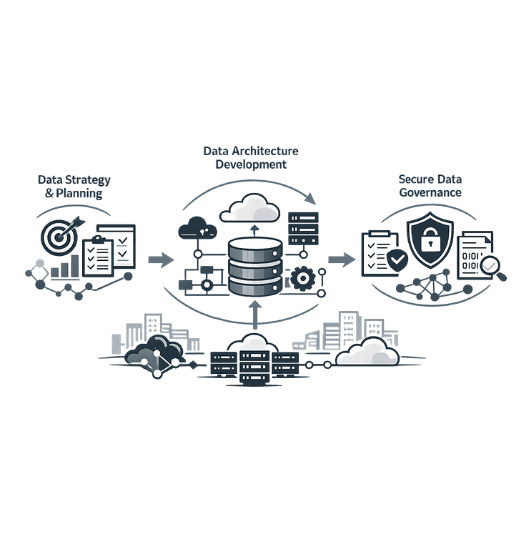
Data Strategy and Planning
Building a successful data ecosystem requires clear planning and aligned business goals. Our data strategy experts identify requirements, define governance frameworks, and create scalable roadmaps that support analytics, automation, and business intelligence initiatives.
Data Architecture Development
Modern enterprises manage data from multiple platforms simultaneously. Our consultants design reliable data architectures that streamline integration, improve accessibility, and support cloud-based storage, analytics, and enterprise-wide digital transformation strategies.
Secure Data Governance
Organizations need secure and compliant data management practices to reduce operational risks. Our experts help establish governance models, data security standards, compliance processes, and efficient data workflows that improve accuracy, accessibility, and decision-making capabilities.

our core value

Whether you have to create a scalable data foundation or transform your current data ecosystem, our Data Strategy & Architecture services will help you unlock the full value of your data.
Create a scalable, secure, and future-proof data architecture
Align your data strategy with business objectives and AI investments
Minimize risks with robust data governance and compliance frameworks

DATA STRATEGY VS DATA ARCHITECTURE


 Data Strategy defines the vision, goals, and roadmap for leveraging data as a business asset, while Data Architecture designs the technical foundation that makes that vision executable, scalable, and secure. Strategy sets the direction architecture builds the structure that delivers it

Enterprise Data Foundation

Build a Scalable and Future-Ready Data Ecosystem

We help organizations create strong data foundations that support analytics, reporting, cloud transformation, and intelligent business operations. By aligning data strategy with business objectives, we enable enterprises to improve visibility, streamline operations, and unlock greater value from enterprise data.

Our approach focuses on building secure, scalable, and connected data architectures that simplify data management, improve governance, and support long-term digital growth across departments and business functions.

our Vision & Our purpose

Enterprise Data Architecture Strategy for Scalable Growth.

We build innovative enterprise data architectures that integrate systems, improve governance, and support secure and scalable data platforms. Our strategy links business objectives to power analytics, AI, and real-time intelligence.We turn fragmented spaces into high-performance data environments that fuel agility, innovation, and sustainable enterprise success.

Frequently Asked Questions

What is Data Strategy and Architecture?
Data Strategy and Architecture refers to the structured approach organizations use to manage, organize, and utilize data as a strategic asset. It combines business objectives with technical frameworks to define how data is collected, stored, processed, governed, and consumed across the enterprise. While data strategy focuses on aligning data initiatives with business goals and outcomes, data architecture provides the blueprint for how systems, platforms, and data flows are designed. Together, they ensure that data is accessible, reliable, scalable, and capable of driving informed decision-making across the organization.
Why is Data Strategy important for modern organizations?
Data Strategy is essential because it enables organizations to move from fragmented, siloed data environments to a unified and value-driven data ecosystem. Without a clear strategy, data initiatives often become reactive, inconsistent, and difficult to scale. A well-defined data strategy ensures that data investments are aligned with business priorities, improves decision-making through trusted data, and supports innovation through advanced analytics and AI. It also helps organizations respond quickly to changing market conditions by providing a consistent and governed view of data across systems.
What is the role of Data Architecture in an organization?
Data Architecture plays a critical role in defining how data is structured, integrated, and managed across systems. It acts as the foundation for all data-related activities by establishing standards, models, and frameworks for data storage, processing, and access. A well-designed data architecture ensures that data flows seamlessly between systems, reduces redundancy, and improves performance. It also supports scalability and flexibility, allowing organizations to adapt to new technologies and evolving business requirements without disrupting existing operations.
What are the key components of Data Strategy and Architecture?
Data Strategy and Architecture consist of several key components, including data governance, data integration, data storage, data modeling, and data consumption. Data governance ensures data quality, security, and compliance, while data integration connects data from multiple sources into a unified view. Data storage solutions, such as data lakes and warehouses, provide scalable infrastructure for managing large volumes of data. Data modeling defines how data is structured and related, and data consumption focuses on enabling access through analytics, reporting, and applications. These components work together to create a cohesive data ecosystem.
How does Data Strategy support business decision-making?
Data Strategy supports business decision-making by ensuring that accurate, timely, and relevant data is available to stakeholders. It enables organizations to move from intuition-based decisions to data-driven insights by providing a consistent and trusted view of information. Advanced analytics and visualization tools allow decision-makers to identify trends, patterns, and opportunities, while predictive models provide foresight into future outcomes. By aligning data initiatives with business objectives, organizations can make more informed and strategic decisions.
What challenges are commonly faced in Data Strategy and Architecture?
Organizations often face challenges such as data silos, inconsistent data quality, lack of governance, and difficulty integrating data across systems. Legacy systems and fragmented architectures can make it difficult to achieve a unified view of data. Additionally, scaling data infrastructure to handle increasing volumes and complexity can be challenging. Addressing these issues requires a strategic approach that includes modernizing data architecture, implementing governance frameworks, and adopting scalable technologies.
What is the importance of data governance in data architecture?
Data governance is a critical component of data architecture, as it ensures that data is accurate, consistent, secure, and compliant with regulations. It defines policies, roles, and responsibilities for managing data across its lifecycle. Governance frameworks help maintain data integrity, prevent unauthorized access, and ensure that data is used responsibly. By embedding governance into the architecture, organizations can build a trusted data environment that supports reliable analytics and decision-making.
How do modern data architectures differ from traditional ones?
Modern data architectures are designed to be more flexible, scalable, and cloud-native compared to traditional architectures. They often incorporate concepts such as data lakes, data fabrics, and data meshes, which enable real-time data processing and integration across distributed systems. Unlike traditional architectures that rely on rigid structures and batch processing, modern approaches support dynamic data flows, automation, and advanced analytics. This allows organizations to respond more quickly to changing business needs and leverage data more effectively.

Let’s Collaborate with Us!

From an early stage start-up’s growth strategies to helping existing businesses, we have done it all! The results speak for themselves. Our services work.