Digital Personal Data Protection

India Didn’t Just Introduce a Law. It Defined an Operating Model.

On 13 November 2025, MeitY formalized the Digital Personal Data Protection Act and its Rules, completing India’s regulatory architecture for digital data governance. What changed is not just compliance expectations, but how systems are expected to operate. With phased enforcement over 18 months, organizations must move away from static, document-based compliance toward systems that continuously enforce data policies. This means shifting from periodic audits to real-time validation, from policy definition to execution-level control, and from reactive compliance to proactive system design.

DPDPA Rewrites How Data Must Flow

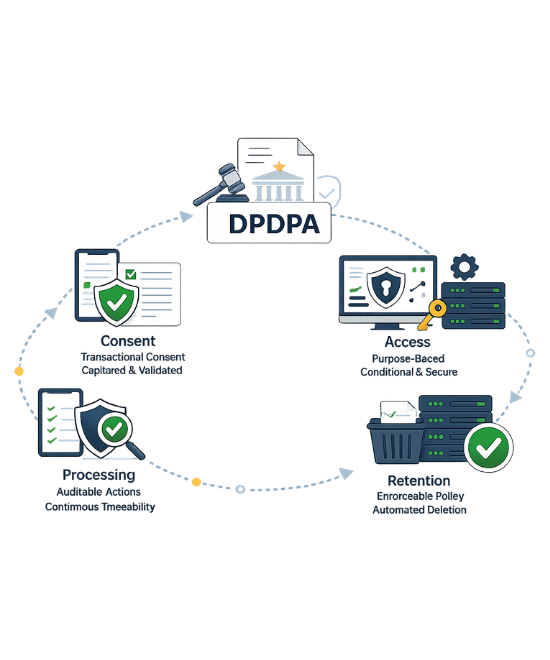
The Act introduces enforceable constraints at every stage of the data lifecycle:

Consent is now transactional — must be captured, stored, and validated at execution time
Data access is conditional — governed by purpose, not just permissions
Retention is enforceable — systems must delete, not just define policies
Processing is traceable — every data action must be auditable
ENFORCEMENT MODEL

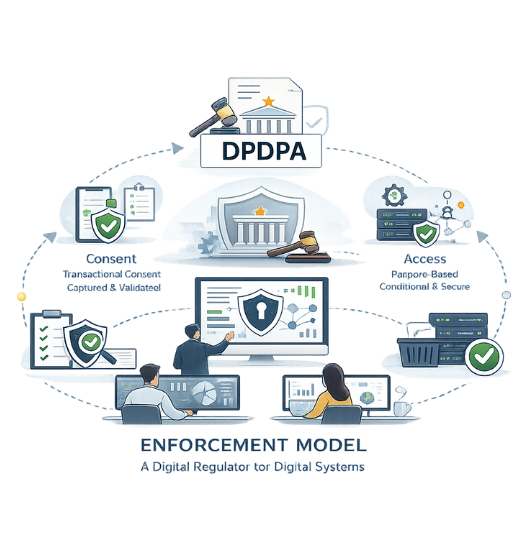
A Digital Regulator for Digital Systems

The Data Protection Board of India is designed as a techno-legal enforcement body that operates digitally rather than through traditional regulatory mechanisms. It evaluates compliance based on how systems behave in real-world conditions, not just on documented policies. With the ability to investigate breaches, adjudicate disputes, and impose significant financial penalties, the Board shifts the focus toward operational accountability. This makes system design, monitoring, and data visibility critical to compliance.

SYSTEM IMPLICATIONS

Where Most Systems Will Fail

Many companies focus on surface-level compliance like policies and consent forms. We focus on what truly matters—data privacy, trust, and protection.
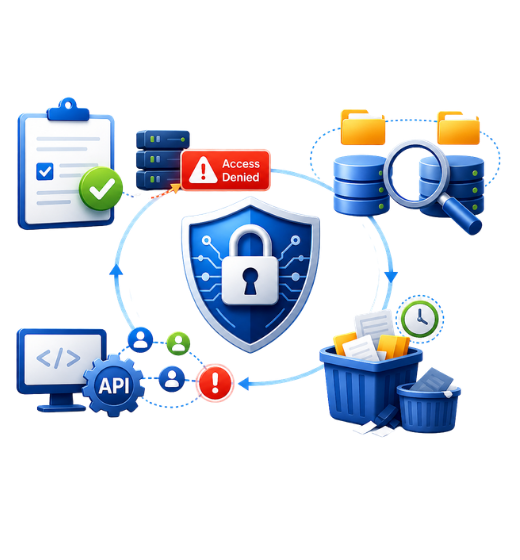
Consent stored but not enforced at execution
Data duplicated without lineage tracking
APIs process data without validating purpose
Retention defined but deletion not automated

Compliance Now Lives in the Stack

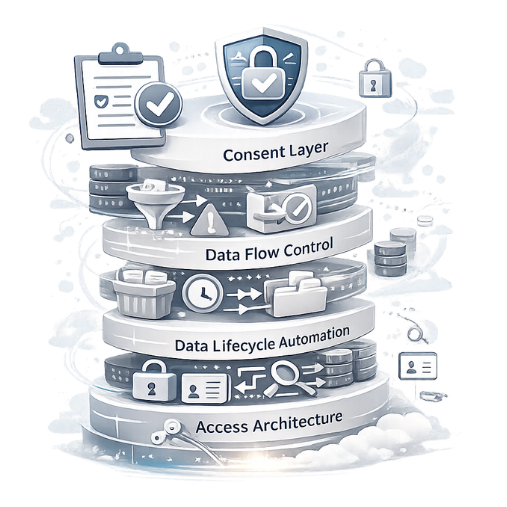
To align with DPDPA, systems must be redesigned across layers:

Consent Layer
dynamic consent validation at runtime
Data Flow Control
enforceable policies across APIs and services
Data Lifecycle Automation
retention, deletion, and archival logic
Observability Layer
full traceability of data movement and usage
Access Architecture
RBAC/ABAC tied to purpose and context
BUSINESS IMPACT

The Cost of Getting This Wrong

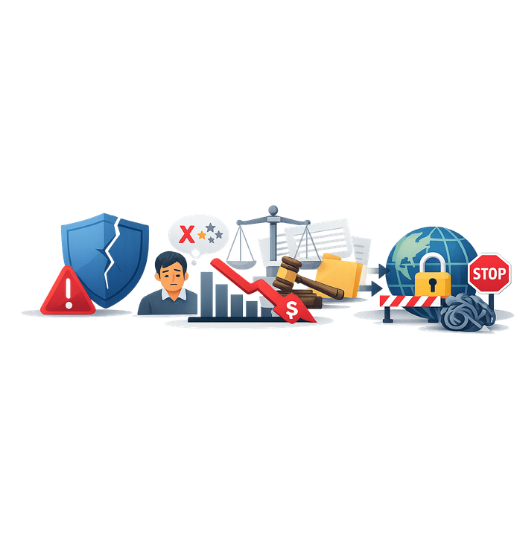
DPDPA is not just a regulatory risk—it is a business risk. Non-compliance can impact customer trust, slow down enterprise adoption, and create barriers in cross-border data operations. More importantly, systems that are not designed for controlled data flow will struggle to scale as regulatory expectations evolve. Organizations that approach this as a legal requirement will face ongoing friction, while those that treat it as a system design challenge will build more resilient and scalable platforms.

Frequently Asked Questions

What is the difference between data privacy and data protection?
Data privacy and data protection are closely related but serve different purposes. Data privacy focuses on how personal and sensitive data is collected, processed, and shared in compliance with regulations and user consent. It defines who can access data and for what purpose. Data protection, on the other hand, focuses on the technical and organizational measures used to secure that data from unauthorized access, breaches, or loss. This includes encryption, access controls, monitoring, and infrastructure security. Together, they form a complete framework where privacy defines policies and protection enforces them through technology.
How do you implement privacy-by-design in modern systems?
Privacy-by-design is implemented by embedding data protection principles directly into system architecture rather than adding them later. This includes minimizing data collection, enforcing strict access controls, encrypting data at every stage, and ensuring that only necessary data is processed. We also design systems to anonymize or pseudonymize sensitive information wherever possible. Additionally, logging, monitoring, and audit mechanisms are integrated to ensure continuous compliance. By building privacy into the system from the start, organizations reduce risk and avoid costly redesigns later.
How do you ensure data security across multiple systems and integrations?
In modern architectures, data flows across APIs, cloud platforms, and third-party systems, making security more complex. We implement a layered approach that includes API security, encryption protocols, identity and access management (IAM), and secure data transmission. Middleware and integration layers are designed to control how data moves between systems, ensuring validation, transformation, and secure handling at every step. Monitoring systems track data flow in real time to detect anomalies. This ensures that even in distributed environments, data remains secure and controlled.
What role does encryption play in data protection?
Encryption is a foundational component of data protection. It ensures that even if data is intercepted or accessed without authorization, it cannot be read or misused. We implement encryption for data at rest (stored in databases or storage systems) and data in transit (moving across networks). Advanced key management practices are also used to control who can decrypt the data. Encryption is combined with other controls like access management and monitoring to create a comprehensive security framework.
How do you manage access control and identity security?
Access control is managed through structured identity and access management (IAM) systems. This includes role-based access control (RBAC) and attribute-based access control (ABAC), ensuring that users can only access the data necessary for their role. Multi-factor authentication (MFA), session management, and privilege escalation controls are also implemented. Access is continuously monitored and audited to detect unauthorized behavior. This ensures that data access is controlled, traceable, and aligned with security policies.
How do you help organizations comply with regulations like GDPR or HIPAA?
Compliance is achieved by aligning both system design and operational processes with regulatory requirements. This includes implementing data classification, consent management, audit trails, and data retention policies. We also ensure that systems support user rights such as data access, modification, and deletion. Regular audits and monitoring help maintain compliance over time. Instead of treating compliance as a checklist, we integrate it into the system architecture, making it a natural outcome of how the system operates.
How do you detect and respond to data security threats?
We implement real-time monitoring and observability systems that track data access, system activity, and anomalies. Security information and event management (SIEM) tools and logging frameworks help identify suspicious behavior. Automated alerts and response mechanisms ensure that threats are detected and addressed quickly. Incident response strategies are also defined to handle breaches effectively. This proactive approach minimizes risk and ensures rapid containment of any potential threats.
What outcomes can organizations expect from a structured data protection system?
Organizations can expect improved data security, reduced risk of breaches, and better compliance with regulations. Data becomes more controlled and visible, enabling better governance and decision-making. Operational efficiency improves as manual security processes are reduced. Systems become more resilient, and user trust increases due to stronger privacy practices. Ultimately, data protection shifts from being a reactive function to a strategic capability that supports business growth and stability.

Let’s Collaborate with Us!

From an early stage start-up’s growth strategies to helping existing businesses, we have done it all! The results speak for themselves. Our services work.