
Engineer Your Revenue Engine with HubSpot—Not Just a CRM Setup
Most organizations invest in CRM platforms but fail to operationalize them. The real value of HubSpot lies not in storing contacts, but in structuring how marketing, sales, and customer success interact through data, automation, and lifecycle orchestration.
THE BUSINESS PROBLEM
Outcome:
Revenue leakage, longer sales cycles, and poor decision-making.
WHAT HUBSPOT SHOULD ACTUALLY DO
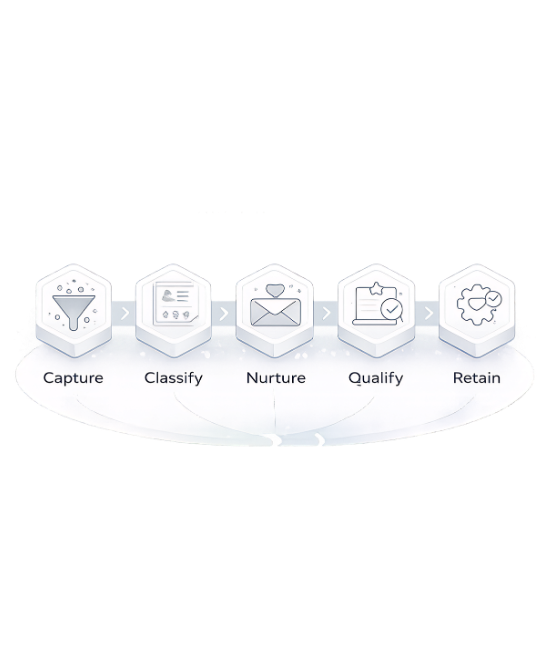
A high-performing HubSpot system should behave like this:
Capture → Classify → Nurture → Qualify → Convert → Retain
That’s the difference between using HubSpot and engineering it.
OUR CORE CAPABILITIES
We approach HubSpot as a Revenue Infrastructure Layer, not a tool deployment
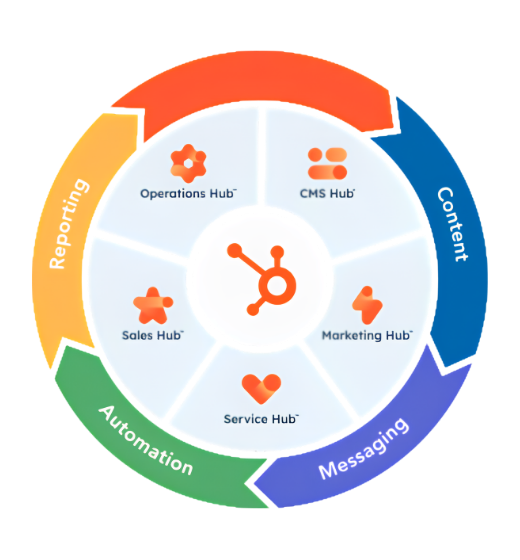
CRM Architecture & Data Modeling
We define how your data behaves inside the system.
Engineering & Automation
Automation is not about convenience—it’s about consistency and speed.
Revenue Intelligence & Attribution
Leadership gains clarity on what is driving revenue—not just activity.
Most CRM setups fail at the reporting layer. We implement structured reporting using HubSpot dashboards integrated with Google Analytics 4 to provide full-funnel visibility. This includes multi-touch attribution, deal velocity tracking, and campaign-to-revenue mapping.

Sales Process Optimization
We enable sales teams with systems, not spreadsheets:
- Lead scoring based on engagement + intent
- Automated deal stage transitions
- Context-rich contact timelines
- Task prioritization and follow-up automation
WHY MOST HUBSPOT IMPLEMENTATIONS FAIL
HubSpot rarely fails as a platform. Failures occur when businesses replicate their existing inefficiencies inside the CRM instead of redesigning them.
Without proper data structure, workflow logic, and lifecycle alignment, even the most powerful tools become underutilized.
Our approach ensures HubSpot is aligned with business logic first, technology second.

INDUSTRY APPLICATIONS
Our strategies are adaptable across industries, with tailored execution for each:

SaaS & Tech
B2B Enterprises
Growth-Stage Startups
Service Businesses
OUTCOMES
We don’t just manage HubSpot—we build a scalable growth system that unifies your marketing, sales, and customer operations.

SaaS & Tech
Faster deal movement
Higher lead conversion rates
Clear attribution visibility
Reduced operational overhead
Frequently Asked Questions
Is HubSpot suitable for complex business models?
We define lifecycle stages, pipeline logic, and automation rules that reflect how leads move, convert, and expand.
This ensures visibility across different revenue streams and customer journeys.
Advanced configurations also support segmentation, reporting, and cross-functional coordination.
With the right structure, HubSpot becomes a system of execution, not just tracking.
This allows it to handle both simplicity and complexity without compromising control.
What is the biggest mistake in CRM implementation?
This leads to systems that mirror inefficiencies instead of solving them.
Lack of process standardization results in inconsistent data and poor adoption.
Over time, this reduces trust in the CRM and limits its impact.
Effective implementation requires rethinking workflows, not just configuring tools.
A well-designed system simplifies operations and improves decision-making.
How do you ensure data accuracy?
Mandatory fields, standardized formats, and automation reduce manual errors.
Clear ownership ensures accountability for data quality across teams.
Consistent data enables reliable reporting, forecasting, and segmentation.
We also implement monitoring and cleanup processes to maintain accuracy over time.
This ensures that data remains a trusted foundation for decision-making.
Can HubSpot replace multiple tools?
Integrations further extend its capabilities across other systems.
This reduces tool sprawl and improves data consistency across platforms.
Having a unified system simplifies workflows and improves visibility.
It also reduces operational overhead and integration complexity.
The result is a more streamlined and efficient tech stack.
How long does it take to see impact?
However, measurable revenue impact builds over time.
As adoption increases and data quality improves, pipeline performance becomes more predictable.
Continuous optimization further enhances results.
The system evolves into a structured engine that supports growth.
Long-term impact comes from consistency and refinement.
Do you support post-implementation optimization?
We continuously refine workflows, automation logic, and data structures.
Performance monitoring helps identify inefficiencies and improvement areas.
Regular updates ensure the system remains aligned with business objectives.
This approach prevents stagnation and maintains system effectiveness.
Ongoing optimization ensures scalability and sustained value.
Is this approach suitable for small teams?
This allows teams to focus on high-value activities rather than repetitive tasks.
Standardized workflows ensure consistency even with fewer people.
As the business grows, the system scales without requiring proportional increases in headcount.
It also provides better visibility and control over operations.
This makes it an effective foundation for early-stage growth.
What makes your approach different?
Workflows are aligned with how revenue is generated and managed.
Automation is designed to guide actions and enforce process consistency.
Data structures are built to support accurate reporting and forecasting.
This ensures the CRM actively contributes to business outcomes.
The result is a system that enables growth, not just tracks activity.
Let’s Collaborate with Us!
From an early stage start-up’s growth strategies to helping existing businesses, we have done it all! The results speak for themselves. Our services work.