Ai Product Engineering

AI Product Engineering
Now-a-Days

AI Product Engineering

AI Product Engineering turns AI from a prototype into a production-ready system by aligning data, models, and deployment—driving scalable, reliable, and measurable outcomes.

Outcomes from AI Product Engineering

Turn AI initiatives into production-ready systems with measurable business impact. Our approach ensures your AI delivers reliability, scalability, and continuous value across its lifecycle. With strong engineering foundations, performance monitoring, and iteration, your AI delivers consistent value across its entire lifecycle—from launch to scale.

Production-ready AI systems
Faster time-to-market
Lower development and operational costs

Unlock the Power of AI Product Engineering

Build intelligent products that are reliable, scalable, and aligned with real business needs. AI Product Engineering helps you move faster, reduce risk, and turn innovation into lasting impact.

AI Product Engineering
Solutions

A complete AI product system — built to move from idea to impact.
Our AI Product Engineering offering gives teams the structure, execution, and technical backbone needed to turn AI concepts into scalable, production-ready products that deliver real business value.
AI Product Engineering Framework

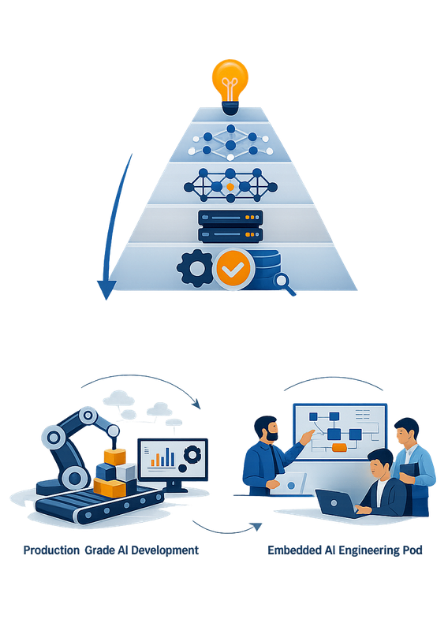
A 6-layer engineering model that identifies the real blockers (problem definition → data → model → architecture → deployment → monitoring) and aligns every build decision with performance, reliability, and business goals.

Production-Grade AI Development

We design, train, and deploy AI systems using robust pipelines, tested architectures, and scalable infrastructure—so models don’t stay in notebooks but run reliably in real-world environments.

Embedded AI Engineering Pod

A dedicated cross-functional team that works with you and for you—AI strategy, data engineering, model development, deployment, and iteration—ensuring your AI product continuously improves without stalling after launch.

Why Teams Trust Our
AI Engineering

Cost-Effective
Get a dedicated AI product pod without the overhead of hiring a full in-house AI team. You save on recruitment, long ramp-up cycles, and costly rework.
Proven AI Build Experience
We’ve built and deployed AI systems across use cases and industries—so we know what scales, what breaks in production, and how to avoid common AI failure points early.
AI+Engineering Intelligence
AI models bring prediction, automation, and learning. Engineering expertise ensures reliability, security, scalability, and real-world usability—so intelligence actually works in production.
Product-First Mindset
We build AI as a product, not a demo. Every decision is driven by user value, system performance, and long-term maintainability—not just model accuracy.
Production & Iteration
We don’t stop at training models—we deploy, monitor, optimize, and iterate continuously. You get stable releases, measurable improvements, and evolving intelligence.
Outcome-Driven Development
Everything is tied to business and product KPIs—accuracy, latency, cost, adoption, and impact. Clear monitoring ensures AI decisions are measurable, explainable, and improvable.

AI Product
Engineering Process

AI Product Launch – The Framework that Scales

A 7-stage model to take AI from problem discovery to production, optimization, and measurable business impact.
1. Problem & Use-Case Definition
Identify the right business problem, target users, and success criteria so AI solves a real, high-impact need.
2. Data Readiness & Strategy
Assess data availability, quality, and governance to ensure models are trained on reliable and relevant inputs.
3. Model Design & Validation
Select, train, and evaluate models that balance accuracy, cost, explainability, and performance.
4. Product & System Architecture
Design scalable AI architecture, APIs, and workflows that integrate smoothly with existing systems.
5. Deployment & Integration
Launch models into production with proper pipelines, security, monitoring, and application integration.
6. Monitoring, Optimization & Iteration
Track accuracy, drift, latency, and usage to continuously retrain, improve, and optimize AI performance.
7. Scale, Governance & Impact Measurement
Expand usage responsibly with compliance, cost control, and clear business KPIs tied to ROI.

AI Product Launch – The Framework that Scales

A 7-stage model to take AI from problem discovery to production, optimization, and measurable business impact.

1. Problem & Use-Case Definition
Identify the right business problem, target users, and success criteria so AI solves a real, high-impact need.
2. Problem & Use-Case Definition
Identify the right business problem, target users, and success criteria so AI solves a real, high-impact need.
3. Problem & Use-Case Definition
Identify the right business problem, target users, and success criteria so AI solves a real, high-impact need.
4. Problem & Use-Case Definition
Identify the right business problem, target users, and success criteria so AI solves a real, high-impact need.
5. Problem & Use-Case Definition
Identify the right business problem, target users, and success criteria so AI solves a real, high-impact need.
6. Problem & Use-Case Definition
Identify the right business problem, target users, and success criteria so AI solves a real, high-impact need.
Our Featured Projects

Selected Case Studies

We Helped Hundreds of Businesses was Back on its Feet. Ut id urna tristique est tincidunt.

Frequently Asked Questions

What is AI Product Engineering?
AI Product Engineering is the end-to-end process of designing, developing, deploying, and maintaining products that leverage artificial intelligence and machine learning technologies. It goes beyond traditional software development by incorporating data pipelines, model training, evaluation, deployment (MLOps), and continuous improvement.

It ensures that AI models are not just built but are scalable, reliable, and aligned with business goals, delivering real-world value through intelligent automation and insights.
How is AI Product Engineering different from traditional software engineering?
AI Product Engineering differs fundamentally from traditional software engineering in both its approach and execution. Traditional systems rely on predefined rules and deterministic logic, meaning they behave predictably based on coded instructions. In contrast, AI systems are probabilistic and data-driven, learning patterns from historical data to make predictions or decisions. This introduces uncertainty, requiring continuous evaluation, retraining, and tuning. Additionally, AI development involves experimentation, feature engineering, and model validation, which are not typically part of standard software workflows. The lifecycle is also more iterative, as models must adapt to new data and changing conditions. As a result, AI Product Engineering integrates disciplines like data science, data engineering, and MLOps alongside traditional development practices.
What are the key components of AI Product Engineering?
AI Product Engineering is built on several critical components that work together to create a robust and scalable system. Data engineering forms the foundation, involving data collection, cleaning, transformation, and storage to ensure high-quality inputs. Model development focuses on selecting appropriate algorithms, training models, and evaluating their performance. Deployment and MLOps enable models to be integrated into production environments, ensuring they can handle real-world workloads efficiently. Integration layers connect AI capabilities with applications, APIs, and user interfaces, allowing seamless interaction with other systems. Governance and security ensure compliance with regulations, protect sensitive data, and maintain transparency and accountability. Together, these components form a cohesive ecosystem that supports the full lifecycle of AI products.
Why is MLOps important in AI Product Engineering?
MLOps plays a crucial role in bridging the gap between experimental AI development and real-world production systems. It introduces structured processes and automation to manage the lifecycle of machine learning models, including versioning, testing, deployment, and monitoring. Without MLOps, organizations often struggle with deploying models consistently, tracking changes, and maintaining performance over time. MLOps ensures that models can be updated seamlessly as new data becomes available, reducing downtime and improving reliability. It also enhances collaboration between data scientists, engineers, and operations teams by standardizing workflows and tools. Ultimately, MLOps enables organizations to scale AI initiatives efficiently while maintaining control, transparency, and performance.
What industries can benefit from AI Product Engineering?
AI Product Engineering has wide-ranging applications across virtually every industry that relies on data-driven decision-making. In healthcare, it enables predictive diagnostics, personalized treatment plans, and improved patient outcomes. In finance, it supports fraud detection, credit scoring, and risk management. Retail and e-commerce benefit from recommendation systems, demand forecasting, and customer behavior analysis. Manufacturing leverages AI for predictive maintenance, quality control, and process optimization, while telecommunications uses it for network optimization and customer experience enhancement. Beyond these, industries such as logistics, energy, and education are also adopting AI-driven solutions to improve efficiency, reduce costs, and gain competitive advantages.
How do you ensure data quality in AI systems?
Ensuring data quality is one of the most critical aspects of AI Product Engineering, as the accuracy and reliability of AI models depend heavily on the data they are trained on. This involves implementing robust data validation processes to detect and correct errors, inconsistencies, and missing values. Data cleansing techniques are applied to remove noise and standardize formats, while normalization ensures consistency across datasets. Continuous monitoring of data pipelines helps identify anomalies and maintain data integrity over time. Additionally, organizations establish data governance frameworks to define policies, roles, and responsibilities for managing data. By maintaining high data quality, organizations can ensure that their AI systems produce accurate, reliable, and trustworthy outcomes.
What challenges are commonly faced in AI Product Engineering?
AI Product Engineering presents several challenges that require careful planning and expertise to overcome. One of the primary challenges is obtaining high-quality, relevant data, as incomplete or biased data can significantly impact model performance. Integrating AI solutions with existing legacy systems can also be complex, requiring additional effort to ensure compatibility and scalability. Managing model bias and ensuring fairness is another critical concern, particularly in sensitive applications such as finance and healthcare. Additionally, maintaining model performance over time, especially in dynamic environments where data patterns change, can be difficult. Addressing these challenges requires a combination of technical skills, domain knowledge, and strong governance practices.
What is model drift and how is it managed?
Model drift refers to the gradual decline in the performance of a machine learning model due to changes in the underlying data distribution or external factors. This can occur when new data differs significantly from the data used during training, leading to inaccurate predictions. To manage model drift, organizations implement continuous monitoring systems that track model performance metrics in real time. When performance drops below a certain threshold, alerts are triggered, prompting retraining or recalibration of the model using updated data. Version control and automated pipelines are also used to ensure smooth updates and maintain consistency. By proactively managing model drift, organizations can ensure that their AI systems remain accurate and effective over time.

Let’s Collaborate with Us!

From an early stage start-up’s growth strategies to helping existing businesses, we have done it all! The results speak for themselves. Our services work.