THE REAL PROBLEM

Where Most Data Migrations Break

Where Most Data Migrations Break

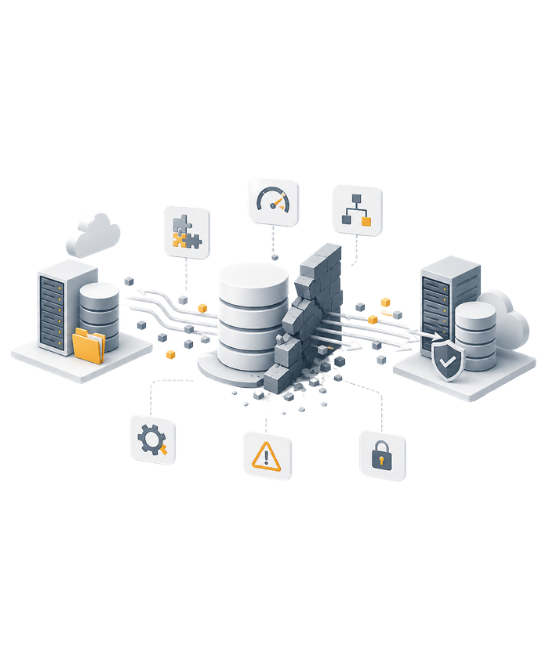
Data migration projects rarely fail during transfer—they fail in what follows. Data arrives incomplete, relationships are lost, schemas don’t align, and downstream systems behave unpredictably.

Legacy data carries inconsistencies. Target systems enforce stricter structures. Between the two, transformation logic becomes the weakest link.

What looks like a successful migration often results in:

  • broken reporting
  • inconsistent application behavior
  • hidden data corruption


WHAT WE MIGRATE

Structured Migration Across Data Types
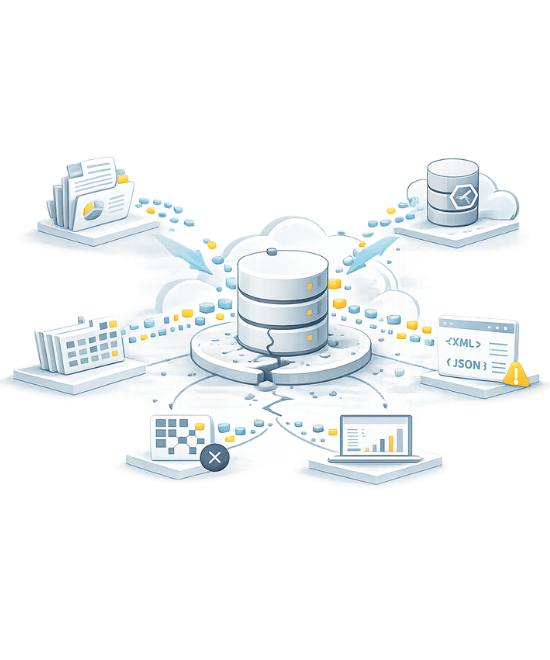
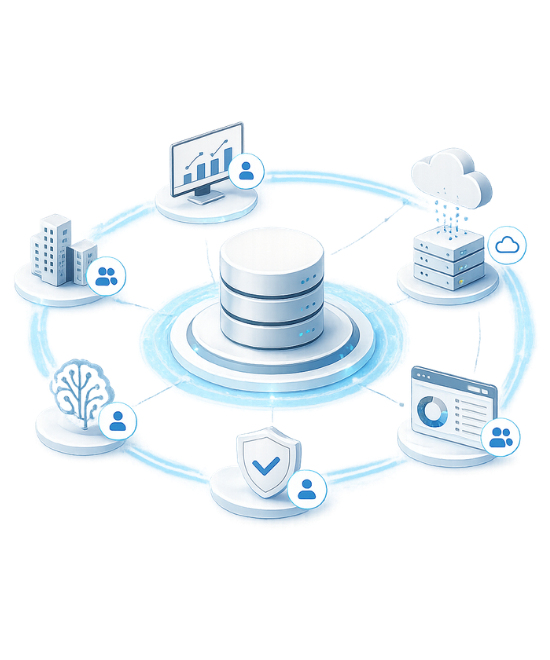
Application Data — user records, transactions, operational datasets
Database Systems — relational and non-relational data migration
Cloud Data Platforms — data lake and warehouse transitions
Legacy Systems — structured extraction from outdated architectures
Metadata & Relationships — preserving data dependencies and integrity
HOW WE APPROACH

Migration as a Controlled Execution Process

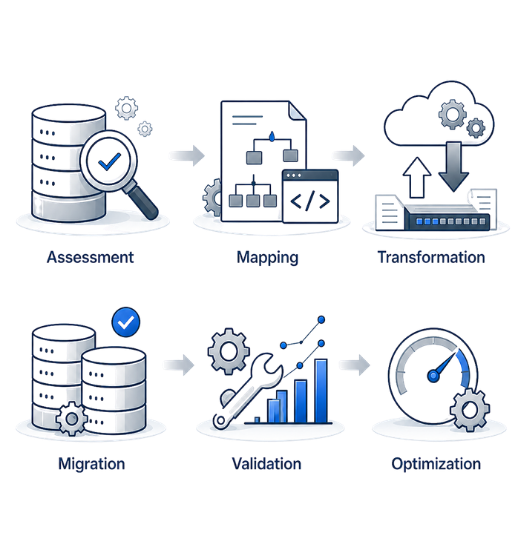
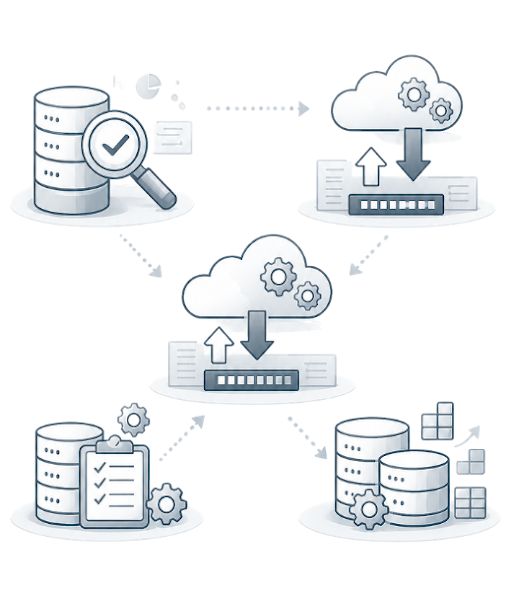
Assessment → Mapping → Transformation → Migration → Validation → Optimization

  • Analyze source system structure and data quality
  • Define schema mapping and transformation logic
  • Execute migration in controlled batches
  • Validate data integrity and completeness
  • Optimize performance post-migration
TECHNICAL CHALLENGES

What Makes Migration Complex

Data migration complexity comes from structural mismatch, not volume.

Schema differences between source and target
Data inconsistencies and duplicates
Dependency handling across systems
Downtime and business continuity constraints
Performance degradation during migration

CORE CAPABILITIES

Data profiling and quality assessment
Schema mapping and transformation pipelines
ETL/ELT pipeline design
Data validation and reconciliation
Incremental and batch migration strategies
WHAT CHANGES

From Data Transfer to System Readiness

When migration is engineered correctly, the target system becomes operational immediately—not after weeks of fixes. Data aligns with application logic, reporting remains consistent, and system performance is preserved.

Migration stops being a risk event and becomes a controlled system transition that enables growth.

WHO IT’S FOR

Built for Data-Driven Platforms

You’re moving from legacy to modern systems
Your data volume and complexity are increasing
You cannot afford data inconsistency post-migration
Your systems depend heavily on data relationships
You need zero-disruption migration execution

Frequently Asked Questions

What is data migration in modern system architecture?
Data migration is the process of transferring data from one system to another while preserving its structure, integrity, relationships, and usability within the target environment. In modern architectures, this is not limited to copying data—it involves schema mapping, transformation logic, validation, and alignment with application behavior. Migration must account for differences in databases, APIs, and system constraints. The goal is to ensure that the target system operates correctly with the migrated data from day one, without requiring extensive post-migration fixes or adjustments.
Why do most data migration projects fail or cause issues post-migration?
Most failures occur not during the data transfer itself, but after migration when systems begin to use the data. Common issues include schema mismatches, incomplete transformations, broken relationships, and data inconsistencies. Legacy data often contains duplicates, missing values, or outdated formats that do not align with modern systems. Without proper validation and transformation, this leads to incorrect reporting, application errors, and performance issues. Migration requires a system-level approach, not just scripts for moving data.
What is the difference between ETL and ELT in data migration?
ETL (Extract, Transform, Load) and ELT (Extract, Load, Transform) are two approaches used in data migration pipelines. In ETL, data is transformed before being loaded into the target system, ensuring it meets required formats and structures upfront. In ELT, data is first loaded into the target system and then transformed using its processing capabilities. The choice depends on system architecture, data volume, and performance requirements. Modern cloud-based systems often prefer ELT due to scalability, while ETL is useful when strict validation is required before loading.
How do you ensure data integrity during migration?
Data integrity is ensured through a combination of data profiling, validation, and reconciliation processes. Before migration, data is analyzed to identify inconsistencies, duplicates, and missing values. During migration, transformation rules are applied to align data with the target schema. Post-migration, validation checks compare source and target datasets to ensure completeness and accuracy. Logging, auditing, and automated validation scripts help detect discrepancies. This structured approach ensures that the migrated data is reliable and consistent.
How do you handle large-scale or high-volume data migrations?
Large-scale migrations require careful planning and execution to avoid performance issues and downtime. We use strategies such as batch processing, incremental migration, and parallel data transfer to manage high volumes efficiently. Data is migrated in phases to reduce system load and ensure continuity. Performance monitoring and resource optimization are applied throughout the process. This ensures that migration does not disrupt business operations while maintaining speed and accuracy.
How do you minimize downtime during data migration?
Downtime is minimized through strategies such as phased migration, replication, and synchronization. Instead of migrating all data at once, systems are kept in sync during the transition period. Techniques like blue-green deployment or shadow migration allow testing in parallel environments before switching to the new system. This ensures that the final cutover happens with minimal disruption. The goal is to maintain business continuity while transitioning systems seamlessly.
How do you validate that the migration was successful?
Validation involves multiple layers of checks to ensure that the migrated data behaves correctly in the target system. This includes record-level validation, schema validation, and functional testing within applications. Data reconciliation compares source and target datasets to confirm completeness. Additionally, performance testing ensures that the system operates efficiently with the new data. Only after all validations are completed is the migration considered successful.
What outcomes can organizations expect from a well-executed data migration?
A well-executed data migration results in a system that is immediately operational, with consistent data, stable performance, and accurate reporting. It eliminates data inconsistencies, reduces technical debt, and enables smoother system transitions. Organizations benefit from improved scalability, better data accessibility, and enhanced decision-making capabilities. Most importantly, it ensures that the migration supports business growth rather than introducing new risks or inefficiencies.


Let’s Collaborate with Us!

From an early stage start-up’s growth strategies to helping existing businesses, we have done it all! The results speak for themselves. Our services work.