System Integration

Where Integration Breaks

Disconnected Systems Create Invisible Failures

  • Most systems are integrated at a surface level—basic API connections, manual data syncs, or isolated workflows
  • Initially, these integrations work but begin to break as system complexity increases
  • Data does not sync in real time across systems
  • Dependencies between systems become fragile and unreliable
  • Workflows fail silently without immediate visibility
  • These issues are not always visible but directly impact product performance
  • Decision-making is affected due to inconsistent or outdated data
  • User experience degrades as systems become unreliable
  • Without structured integration architecture, failures are not obvious
  • Systems don’t fail loudly—they fail quietly and continuously
 
 
WHAT WE BUILD

Integration Architecture That Scales with Your Product

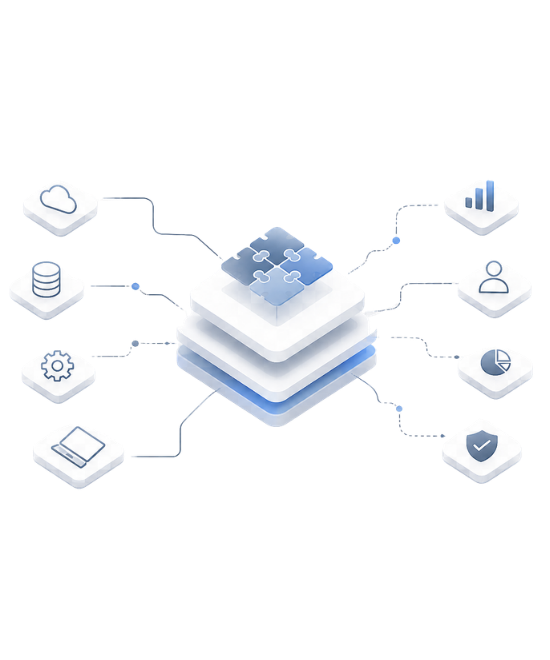
We design system integration at the architecture level, not just the connection level. Instead of creating isolated API links between systems, we define how data flows, how services interact, and how dependencies are managed across the entire ecosystem.

Core Integration Capabilities:
API Integration — REST, GraphQL, and custom API orchestration
Event-Driven Systems — webhooks, message queues, and real-time triggers
Data Synchronization — bi-directional, real-time data consistency
Middleware Engineering — centralized integration layers for system orchestration
Legacy System Integration — connecting modern systems with legacy infrastructure
HOW IT WORKS

Integration as a Controlled System

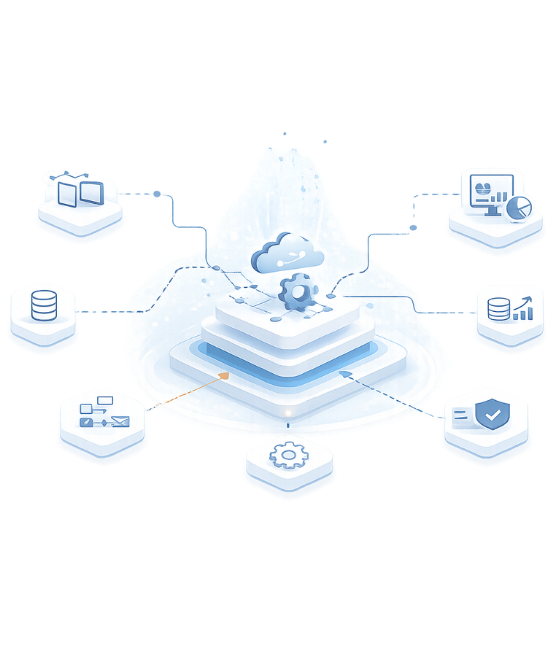
The integration flow operates as a structured pipeline where data moves from source systems through an integration layer into processing logic before reaching target systems, with continuous monitoring at every stage. Data is captured from multiple systems using APIs and event-driven mechanisms, then transformed, validated, and processed based on defined business rules. It is routed to the appropriate systems in real time, ensuring consistency and accuracy across the ecosystem. Throughout this process, monitoring tracks failures, delays, and inconsistencies, while ongoing optimization based on usage patterns ensures the system remains efficient, reliable, and scalable.


INTEGRATION AREAS

Where Integration Creates Impact

Product Integrations — connect core product features with external platforms
CRM & Marketing Systems — ensure consistent data flow across sales and marketing tools
Data & Analytics Platforms — centralize data for reporting, insights, and decision-making
Payment & Third-Party Services — enable secure and reliable external service integrations
Internal System Workflows — automate processes across internal tools and platforms
WHAT CHANGES

From Fragile Connections to Reliable Systems

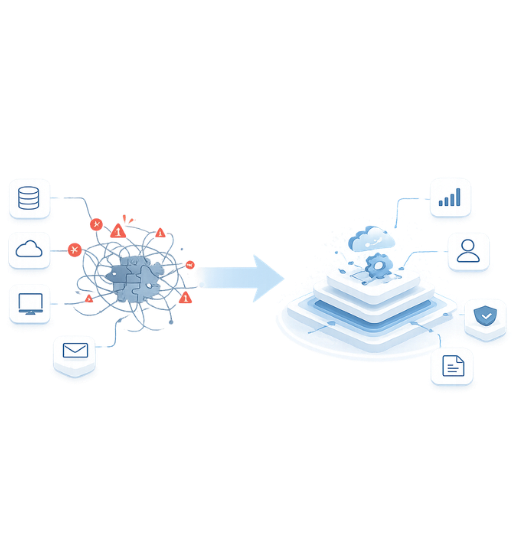
When integration is engineered correctly, systems move away from fragile, point-to-point connections toward a structured and reliable architecture. Data flows become consistent, workflows execute seamlessly without failures, and system dependencies are managed proactively rather than reactively. As a result, the product evolves from a set of loosely connected tools into a cohesive, synchronized system that operates with stability and predictability.

Over time, this structured integration approach also improves system resilience and scalability. Changes in one system no longer disrupt others, as dependencies are clearly defined and managed through controlled interfaces. 

WHO IT’S FOR

Built for Products with Growing Complexity
This is for you if:
Your product depends on multiple systems and tools
Data inconsistencies are impacting decisions
Integrations are breaking as you scale
You need real-time, reliable system communication
Your current integrations are hard to maintain

Frequently Asked Questions

What does system integration mean in product engineering?
System integration in product engineering refers to designing and implementing a structured architecture that enables multiple systems—such as CRMs, APIs, databases, and third-party services—to communicate and operate as a unified system. It goes beyond simple API connections and focuses on data flow, orchestration, and execution logic across systems. This includes real-time synchronization, transformation of data between systems, and ensuring that workflows execute consistently. A well-designed integration layer ensures that your product ecosystem behaves as a single coordinated system rather than disconnected tools.
How is your approach different from basic API integrations?
Basic API integrations typically involve point-to-point connections between two systems, often without considering scalability, error handling, or long-term maintainability. Our approach focuses on building a centralized integration layer using middleware, event-driven architecture, and orchestration logic. This ensures that integrations are not tightly coupled, reducing the risk of failures when systems change. We also incorporate monitoring, retry mechanisms, and validation to ensure reliability. The goal is to create an integration system that is scalable, observable, and resilient.
Can you integrate both modern and legacy systems?
Yes, we specialize in integrating both modern cloud-native systems and legacy infrastructure. Legacy systems often lack modern APIs, so we use techniques such as custom connectors, middleware layers, and data transformation pipelines to enable seamless communication. This allows organizations to modernize their architecture incrementally without replacing critical systems. By bridging legacy and modern platforms, we ensure continuity while improving system performance and flexibility.
How do you ensure real-time data synchronization across systems?
We implement event-driven architectures using webhooks, message queues, and streaming mechanisms to ensure real-time data flow. Instead of relying on periodic batch updates, systems communicate through events triggered by user actions or system changes. Data is validated, transformed, and routed instantly to relevant systems. This minimizes latency, reduces inconsistencies, and ensures that all systems operate with the most up-to-date information. Monitoring and retry logic further ensure that no data is lost during transmission.
What challenges do businesses face without proper system integration?
Without structured integration, businesses experience data inconsistencies, delayed workflows, and operational inefficiencies. Systems may not reflect accurate information, leading to poor decision-making. Manual data handling increases the risk of errors, and dependencies between systems become fragile. Over time, these issues create hidden operational risks, slow down execution, and impact user experience. Proper integration eliminates these challenges by ensuring consistent data flow and reliable system interactions.
How do you handle failures and errors in integrations?
We design integrations with built-in resilience mechanisms such as error handling, retries, logging, and alerting. If a failure occurs, the system can automatically retry the operation or route it through fallback workflows. Detailed logging ensures that issues can be traced and resolved quickly. Monitoring tools provide real-time visibility into integration performance, allowing proactive identification of issues. This ensures that failures do not disrupt the overall system and are managed efficiently.
How long does it take to implement a system integration solution?
The timeline depends on the complexity of your systems, the number of integrations, and the required logic. Simple integrations can be implemented within a few weeks, while complex architectures involving multiple systems, data transformations, and event-driven workflows may take longer. The process typically includes system analysis, architecture design, implementation, testing, and optimization. We prioritize high-impact integrations first to deliver early value while building a scalable foundation for future needs.
What outcomes can we expect from a well-designed integration system?
A well-designed integration system ensures consistent data flow, reliable workflows, and improved system performance. It reduces manual effort, eliminates data inconsistencies, and enables real-time decision-making. Systems become more resilient, and dependencies are managed effectively. As a result, your product operates as a unified ecosystem, supporting scalability and growth without operational bottlenecks. This leads to better user experience, faster execution, and more predictable system behavior.

Let’s Collaborate with Us!

From an early stage start-up’s growth strategies to helping existing businesses, we have done it all! The results speak for themselves. Our services work.