



From ERP Implementation to Digital Core Enablement

Enterprise Value Realization

SAP is not merely a system of record — it is the digital backbone of an intelligent enterprise. Organizations today require more than transactional efficiency; they need integrated, real-time systems that drive strategic decision-making across functions.
At Techaivv, we architect SAP landscapes that unify enterprise data, standardize processes, and enable end-to-end visibility across finance, supply chain, and operations.

  • Establish a single, governed source of enterprise truth
  • Eliminate process fragmentation across business units
  • Enable real-time financial and operational intelligence
  • Drive agility through standardized and scalable processes
Enterprise-Wide SAP Solutioning Across Core Domains

SAP Capability Architecture

Financial Systems Transformation
(SAP FI/CO)

Drive financial transparency, compliance, and real-time reporting across global entities

Supply Chain & Logistics
(SAP SCM)

Enable demand-driven supply chains with end-to-end visibility and optimization

Human Capital & Experience
(SuccessFactors)

Digitize workforce operations and enhance employee lifecycle management

Digital Core Modernization
(SAP S/4HANA)

Transition to an in-memory, real-time ERP backbone built for speed and scale

Enterprise Analytics (SAP Analytics
Cloud)

Deliver predictive insights, planning capabilities, and unified reporting

Procurement & Spend Management

Streamline sourcing, supplier collaboration, and spend visibility to drive cost efficiency and procurement agility

Industry-Specific SAP Transformation

Designed for Industry Complexity, Not Generic Processes

Our SAP solutions are tailored to industry-specific operational models, ensuring relevance, faster adoption, and measurable impact.

Manufacturing
Advanced production planning, asset optimization, and shop-floor integration
Retail & Commerce
Demand forecasting, omnichannel operations, and inventory intelligence
Healthcare
Compliance-driven workflows and operational efficiency across care systems
Financial Services
Regulatory alignment, risk management, and financial consolidation
Logistics & Distribution
Real-time tracking, warehouse optimization, and network visibility
How It Work

Our SAP Delivery Model

The Intelligent Enterprise Powered by SAP

Modern enterprises are rapidly evolving from traditional ERP-driven operations to intelligent, connected business ecosystems powered by real-time data, automation, and AI-driven decision-making. SAP is at the center of this transformation, enabling organizations to unify operations, streamline enterprise workflows, and build agile digital cores capable of adapting to constant market change. Beyond transactional processing, SAP now serves as a strategic enterprise platform that connects finance, supply chain, procurement, workforce management, analytics, and customer operations into a single intelligent architecture.

At the center of this transformation is SAP, serving as the foundation for next-generation enterprise modernization. What was once viewed primarily as an ERP platform for managing finance and operations has now evolved into a comprehensive intelligent enterprise ecosystem that integrates core business functions, digital workflows, analytics, AI capabilities, and cloud-driven innovation into a unified architecture.

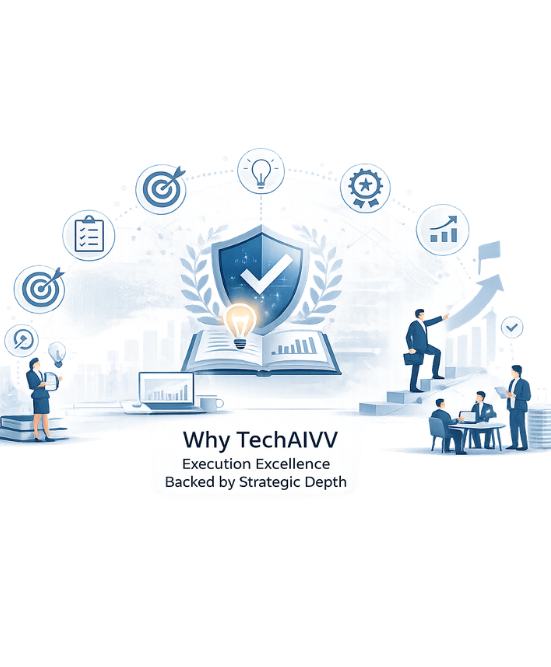
Why Techaivv

Execution Excellence Backed by Strategic Depth

We combine deep SAP expertise with a consulting-led approach, ensuring every engagement delivers measurable business value.

Proven experience across complex SAP transformations
Strong alignment between business strategy and system design
Expertise in multi-module SAP environments
Focus on operational efficiency and measurable ROI
Long-term partnership model for continuous innovation

Frequently Asked Questions

What makes SAP different from other ERP systems?
SAP stands out from other ERP systems because of its ability to manage highly complex, enterprise-scale operations across multiple business functions within a unified ecosystem. Unlike many traditional ERP platforms that focus primarily on transactional processes, SAP delivers deep integration across finance, supply chain, manufacturing, procurement, human resources, analytics, and customer operations. Its architecture is designed to support global enterprises with large-scale operations, multi-country compliance requirements, and high-volume transactional environments. SAP also provides advanced capabilities such as real-time analytics, intelligent automation, predictive insights, and industry-specific process frameworks, making it more than just an ERP platform. It acts as the digital core of the enterprise, enabling organizations to achieve operational visibility, process standardization, and strategic agility at scale.
What is SAP S/4HANA?
SAP S/4HANA is SAP’s next-generation intelligent ERP platform built on the SAP HANA in-memory database. Unlike traditional ERP systems that rely on disk-based processing, S/4HANA processes data directly in memory, enabling real-time analytics, faster transactions, and significantly improved system performance. It is designed to simplify enterprise operations by reducing data redundancy, streamlining workflows, and delivering a more intuitive user experience. SAP S/4HANA supports advanced technologies such as artificial intelligence, machine learning, predictive analytics, and automation, helping organizations transition toward intelligent enterprise operations. It also enables businesses to operate with greater speed, agility, and scalability while supporting cloud, on-premise, and hybrid deployment models.
Is SAP only for large enterprises?
Although SAP is widely recognized for serving large global enterprises, it also provides scalable solutions designed specifically for mid-sized and growing businesses. SAP offers flexible deployment models and modular capabilities that allow organizations to adopt solutions based on their operational complexity and business requirements. Mid-sized companies can leverage SAP to improve financial management, streamline operations, enhance reporting capabilities, and support future growth without needing to invest in overly complex infrastructure from the start. As businesses expand, SAP solutions can scale alongside them, making the platform a long-term strategic investment rather than a short-term operational tool.
Can SAP integrate with existing software?
Yes, SAP is designed to integrate seamlessly with a wide range of enterprise applications, third-party platforms, and legacy systems. Through APIs, middleware platforms, SAP Integration Suite, and enterprise integration frameworks, SAP can connect with CRM systems, e-commerce platforms, data warehouses, cloud applications, analytics tools, and operational systems. This integration capability enables organizations to create a connected enterprise ecosystem where data flows securely and consistently across departments and business functions. By integrating SAP with existing systems, businesses can eliminate operational silos, improve process efficiency, and ensure real-time visibility across the organization without completely replacing their current technology landscape.
How complex is SAP implementation?
SAP implementation can be complex because it often involves large-scale process transformation, system integration, data migration, and organizational change management. The complexity depends on factors such as the size of the organization, the number of modules being implemented, the level of customization required, and the condition of existing systems. However, with the right implementation strategy and experienced SAP partner, the process can be structured efficiently and executed in a controlled manner. A successful implementation typically includes detailed business analysis, architecture planning, process standardization, testing, training, and phased deployment. Proper governance and planning help minimize operational disruption while ensuring that the SAP environment aligns closely with business goals and long-term transformation objectives.
What is the cost of implementing SAP?
The cost of implementing SAP varies depending on several factors, including the scope of the project, the number of users, selected modules, deployment model, customization requirements, and integration complexity. While SAP implementations can represent a significant investment, they are generally viewed as long-term strategic initiatives that deliver measurable operational and financial value over time. Organizations benefit from improved efficiency, process automation, real-time visibility, and scalable enterprise operations, which contribute to long-term ROI. Additionally, cloud-based deployment options and modular implementation approaches allow businesses to manage costs more effectively while scaling capabilities as organizational needs evolve.
Do you help with SAP migration (legacy to S/4HANA)?
Yes, we provide comprehensive SAP migration services to help organizations transition from legacy ERP systems or older SAP environments to SAP S/4HANA. Our migration approach includes assessment, roadmap planning, architecture design, data migration, system integration, testing, and post-migration optimization. We ensure that critical business data and processes are migrated securely and accurately while minimizing downtime and operational disruption. Beyond technical migration, we also focus on process modernization and performance optimization to help organizations fully leverage the advanced capabilities of SAP S/4HANA, including real-time analytics, automation, and intelligent enterprise functionality.
Do you offer SAP consulting services?
Yes, we provide end-to-end SAP consulting services designed to help organizations maximize the value of their SAP investments. Our consulting services include enterprise architecture planning, SAP strategy development, implementation, customization, migration, integration, optimization, and ongoing support. We work closely with stakeholders to understand operational challenges, business goals, and transformation objectives, ensuring that the SAP environment is aligned with long-term enterprise strategy. In addition to technical implementation, we focus on governance, scalability, process efficiency, and user adoption to deliver sustainable business outcomes. Our consulting-led approach ensures that SAP becomes not just a system implementation, but a foundation for enterprise-wide transformation and innovation.

Let’s Collaborate with Us!

From an early stage start-up’s growth strategies to helping existing businesses, we have done it all! The results speak for themselves. Our services work.