
Cloud Infrastructure That Thinks, Scales & Self-Optimizes
Move beyond basic cloud setups. Build intelligent, resilient infrastructure engineered for performance, cost efficiency, and continuous availability.
Cloud is No Longer Infrastructure—It’s a Runtime Environment
- Modern cloud environments are dynamic systems where compute, storage, and networking continuously adapt to workload demands. Simply deploying applications on the cloud is not enough. Without proper architecture, observability, and automation, cloud environments become expensive, unstable, and difficult to manage.
- Cloud engineering ensures that infrastructure behaves predictably—even under unpredictable conditions.
- It also enables efficient resource utilization and cost optimization by dynamically scaling infrastructure based on real-time demand and usage patterns.
WHAT WE SOLVE
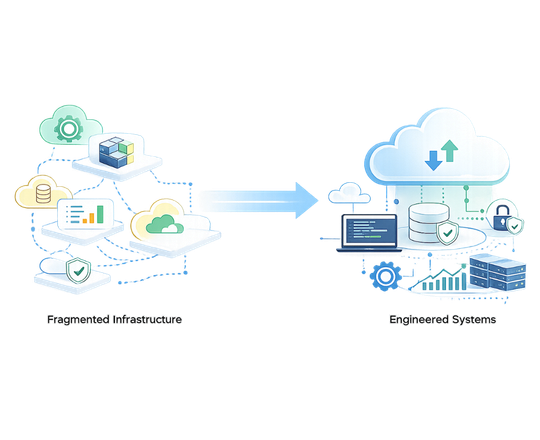
From Fragmented Infrastructure to Engineered Systems
Most organizations face hidden inefficiencies:
Over-provisioned resources increasing costs
Under-optimized workloads causing latency
Lack of visibility into system behavior
But more importantly—there’s no control layer.
CORE CLOUD MODULES
Core Engineering Layers We Build
OUR CORE SERVICES
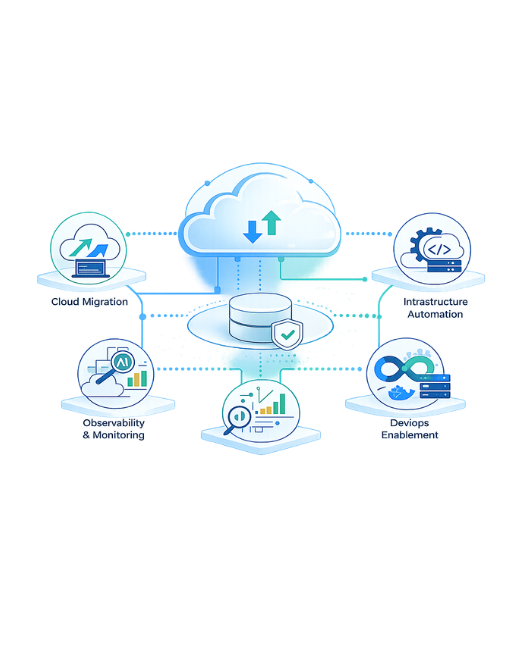
Cloud Migration
We redesign applications for the cloud instead of simply moving them. This ensures better performance, lower cost, and long-term scalability.
Infrastructure Automation
➤ Infrastructure as Code (Terraform, CloudFormation)
➤ Automated provisioning and scaling
➤ Environment consistency across stages
➤ Automated provisioning and scaling
➤ Environment consistency across stages
Observability & Monitoring
We implement deep monitoring systems that track metrics, logs, and traces—allowing proactive issue detection and faster recovery.
DevOps Enablement
Continuous delivery is built into the system:
➤ CI/CD pipelines
➤ Container orchestration (Docker, Kubernetes)
➤ Release automation
➤ CI/CD pipelines
➤ Container orchestration (Docker, Kubernetes)
➤ Release automation
IMPLEMENTATION MODEL
How We Approach Cloud Engineering
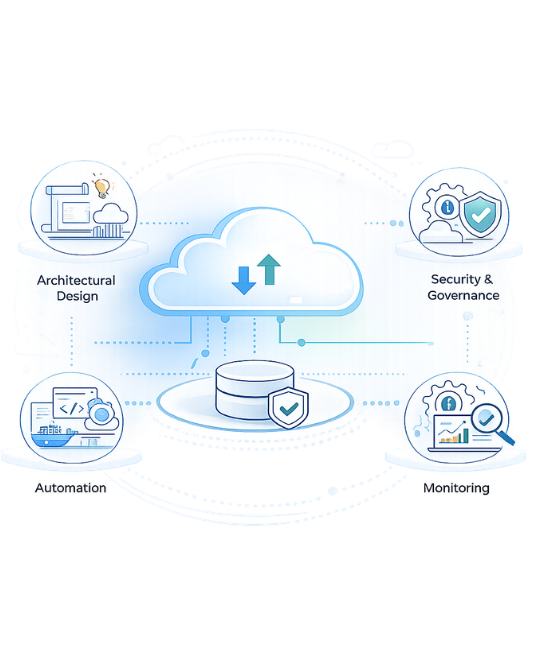
We begin by understanding workload behavior—not just infrastructure.
Then we define how the system should respond under load, failure, and scale.
Architecture is designed
Automation layers are introduced
Monitoring is embedded into the system
Security and governance controls are integrated
Real-World Impact Across Use Cases
Our strategies are adaptable across industries, with tailored execution for each:

High-Growth SaaS
Handles sudden traffic spikes without downtime
Data-Intensive Systems
Processes large datasets with optimized compute and storage
Enterprise Platforms
Maintains compliance, security, and uptime across regions
Startups
Runs lean infrastructure without overspending
OUTCOMES
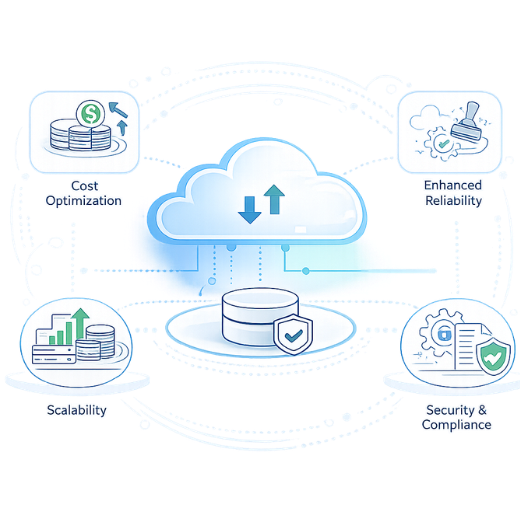
What Changes After Proper Cloud Engineering
Less downtime through resilient architecture and proactive monitoring.
Controlled costs through optimized resource allocation and efficient scaling.
Faster deployments through automated pipelines and streamlined release processes.
Better system visibility through real-time monitoring and observability.
Higher reliability through resilient architecture and automated recovery.
Frequently Asked Questions
What is cloud engineering?
Cloud engineering focuses on designing, building, and managing cloud infrastructure that supports applications, data, and services. It goes beyond deployment by ensuring systems are scalable, reliable, and optimized for performance.
It involves architecture design, automation, monitoring, and security implementation. Modern cloud engineering treats infrastructure as a dynamic system that adapts to workload demands.
This ensures consistent performance even under changing conditions.
It plays a key role in enabling digital transformation and scalable operations.
It involves architecture design, automation, monitoring, and security implementation. Modern cloud engineering treats infrastructure as a dynamic system that adapts to workload demands.
This ensures consistent performance even under changing conditions.
It plays a key role in enabling digital transformation and scalable operations.
How is cloud engineering different from cloud deployment?
Cloud deployment is about moving applications to the cloud, while cloud engineering focuses on how those systems are designed and managed over time.
Without proper engineering, cloud environments can become inefficient and unstable.
Cloud engineering ensures systems are structured for scalability, resilience, and cost control.
It introduces automation, monitoring, and governance into the environment.
This transforms the cloud from a hosting platform into a controlled system.
Without proper engineering, cloud environments can become inefficient and unstable.
Cloud engineering ensures systems are structured for scalability, resilience, and cost control.
It introduces automation, monitoring, and governance into the environment.
This transforms the cloud from a hosting platform into a controlled system.
How do you ensure scalability in cloud environments?
Scalability is achieved by designing systems that can automatically adjust resources based on demand.
We use auto-scaling, load balancing, and distributed architectures to handle growth.
Cloud-native designs ensure systems can scale without manual intervention.
This prevents performance issues during peak usage.
It also ensures efficient use of resources and cost optimization.
We use auto-scaling, load balancing, and distributed architectures to handle growth.
Cloud-native designs ensure systems can scale without manual intervention.
This prevents performance issues during peak usage.
It also ensures efficient use of resources and cost optimization.
How do you manage cloud costs effectively?
Cloud cost management is achieved through optimized resource allocation and continuous monitoring.
We identify unused or underutilized resources and eliminate waste.
Auto-scaling ensures resources are only used when needed.
Cost tracking tools provide visibility into spending patterns.
This allows businesses to maintain control while scaling efficiently.
We identify unused or underutilized resources and eliminate waste.
Auto-scaling ensures resources are only used when needed.
Cost tracking tools provide visibility into spending patterns.
This allows businesses to maintain control while scaling efficiently.
How do you ensure system reliability in the cloud?
Reliability is ensured through resilient architecture, redundancy, and automated recovery mechanisms.
Systems are designed to handle failures without affecting users.
Failover strategies and backups ensure continuity.
Monitoring tools detect issues early and trigger corrective actions.
This ensures consistent uptime and performance.
Systems are designed to handle failures without affecting users.
Failover strategies and backups ensure continuity.
Monitoring tools detect issues early and trigger corrective actions.
This ensures consistent uptime and performance.
What role does automation play in cloud engineering?
Automation is a core component of cloud engineering, enabling faster deployments and consistent operations.
Infrastructure is managed using code, reducing manual errors.
Automated pipelines streamline deployment and updates.
This improves efficiency and reliability across environments.
It also enables teams to focus on innovation rather than maintenance.
Infrastructure is managed using code, reducing manual errors.
Automated pipelines streamline deployment and updates.
This improves efficiency and reliability across environments.
It also enables teams to focus on innovation rather than maintenance.
How do you ensure security in cloud environments?
Security is implemented through access controls, encryption, and continuous monitoring.
Role-based access ensures only authorized users can interact with systems.
Data is protected both in transit and at rest.
Security policies and compliance standards are enforced consistently.
This ensures a secure and compliant cloud environment.
Role-based access ensures only authorized users can interact with systems.
Data is protected both in transit and at rest.
Security policies and compliance standards are enforced consistently.
This ensures a secure and compliant cloud environment.
How do you monitor cloud systems?
Monitoring is achieved through real-time observability tools that track system performance and health.
Metrics, logs, and alerts provide visibility into operations.
This helps detect issues before they impact users.
Continuous monitoring ensures systems remain stable and efficient.
It also supports ongoing optimization and improvement.
Metrics, logs, and alerts provide visibility into operations.
This helps detect issues before they impact users.
Continuous monitoring ensures systems remain stable and efficient.
It also supports ongoing optimization and improvement.
Let’s Collaborate with Us!
From an early stage start-up’s growth strategies to helping existing businesses, we have done it all! The results speak for themselves. Our services work.