
Revenue Shouldn’t Be This Hard to Predict
But your pipeline is inconsistent, forecasts are unreliable, and your CRM feels more like a reporting burden than a revenue system.
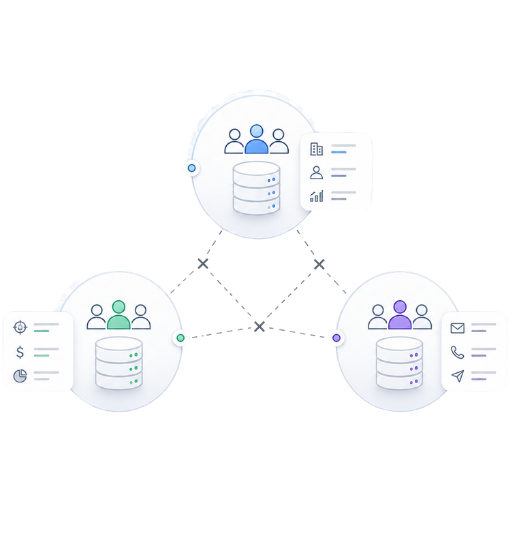
Three Teams, Three Data Sets, No Alignment.
Revenue doesn’t break because teams aren’t working — it breaks because systems aren’t connected. Sales operates on pipeline perception, marketing focuses on lead metrics, and customer success tracks retention signals, but none of them are aligned on a single system. This disconnect creates fragmented execution, inconsistent data, and ultimately, unpredictable revenue.
- Leads go unworked because ownership is unclear
- MQLs inflate metrics but don’t convert
- CRM becomes fragmented with inconsistent usage
- Reporting changes depending on who pulls it
Revenue Operations
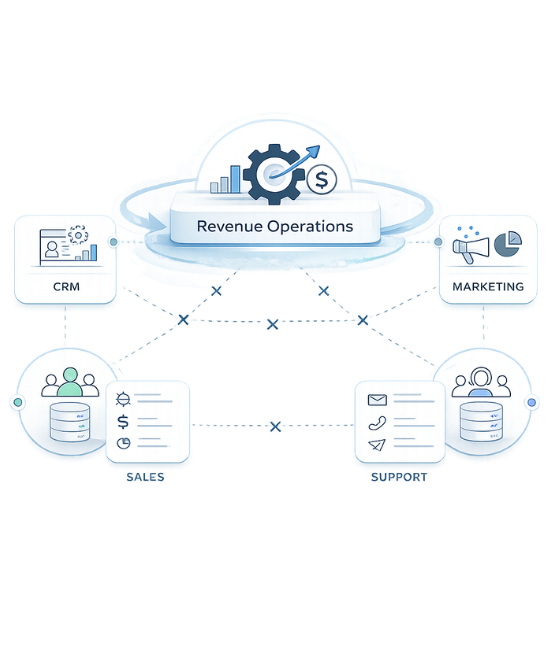
RevOps as the Execution Engine

Revenue Operations acts as the execution layer that aligns systems, processes, and teams into a single revenue engine. Instead of operating in silos, it ensures that every stage — from lead generation to deal closure and customer expansion — follows a structured and connected workflow. RevOps defines clear ownership, standardizes processes, and ensures data flows consistently across Sales, Marketing, and Customer Success. This eliminates manual gaps, reduces inefficiencies, and creates a unified system where every action is aligned with revenue outcomes, making the entire pipeline more predictable, measurable, and scalable.
Scale Across the World Without Rebuilding
AWS allows you to expand globally without redesigning your systems. Its vast infrastructure network ensures low latency and high availability wherever your users are.

What Happens When RevOps Actually Works
Revenue Operations ensures pipeline reflects real deal movement, forecasts align with execution data, and leadership plans with confidence. Handoffs across Marketing, Sales, and Customer Success are automated with context preserved at every stage, eliminating dropped leads and ownership gaps.
Bring Structure to Revenue Execution
Revenue becomes unpredictable when systems are fragmented and teams operate on different data. Without alignment, forecasts shift, handoffs break, and pipeline visibility is lost.
By building a unified revenue operations system, you eliminate gaps, enforce consistency, and create a foundation where forecasting becomes reliable and execution becomes controlled.
What You Achieve

Frequently Asked Questions
What is Revenue Operations
Instead of operating in silos, all teams work from shared processes, data, and metrics.
RevOps integrates CRM systems, automation workflows, and analytics into one structured framework.
It ensures that every stage of the customer lifecycle — from lead to renewal — is connected and optimized.
The focus is not just on execution, but on system design and operational efficiency.
This creates consistency, visibility, and control across the entire revenue engine.
How is RevOps different from Sales Operations or Marketing Operations?
RevOps, on the other hand, unifies all revenue-generating teams under one system.
It eliminates misalignment by standardizing processes, data, and KPIs across departments.
Instead of optimizing individual functions, RevOps optimizes the entire revenue lifecycle.
This ensures smoother handoffs, better collaboration, and consistent pipeline management.
The result is a more efficient and scalable revenue organization.
Why do most RevOps implementations fail?
They implement CRM systems and automation without defining clear workflows and ownership.
This leads to inconsistent data, broken handoffs, and low adoption.
Without governance and structured logic, systems become fragmented over time.
Another major issue is lack of alignment between teams on metrics and definitions.
Successful RevOps requires process-first thinking, followed by automation and system design.
What role does CRM play in RevOps?
It captures, organizes, and tracks all customer interactions across the lifecycle.
However, a CRM alone is not enough — it must be structured and automated properly.
RevOps ensures that CRM workflows reflect real business processes.
Automation within the CRM drives actions such as lead routing, follow-ups, and stage updates.
When implemented correctly, the CRM becomes a trusted system of record and execution.
How does RevOps improve forecasting accuracy?
It standardizes deal stages, qualification criteria, and activity tracking.
Automation ensures that data is updated in real time, reducing manual errors.
Analytics provide visibility into pipeline health, conversion rates, and velocity.
This allows leadership to base forecasts on data rather than assumptions.
The result is more reliable and actionable revenue predictions.
How do you align sales, marketing, and customer success in RevOps?
Each team operates within a unified lifecycle framework.
Clear handoff points ensure smooth transitions between teams.
Shared KPIs ensure that all teams are working toward the same outcomes.
Data consistency ensures everyone is working from a single source of truth.
This eliminates friction and improves collaboration across the revenue organization.
What are the key components of a strong RevOps system?
Process design defines how workflows operate across the lifecycle.
Data management ensures accuracy, consistency, and accessibility.
Automation enforces workflows and reduces manual dependency.
Analytics provide insights into performance and optimization opportunities.
Together, these components create a scalable and efficient revenue system.
How long does it take to implement RevOps effectively?
However, full RevOps implementation is an ongoing process that evolves over time.
It typically takes a few months to stabilize processes and automation.
Continuous monitoring and optimization are required for long-term success.
The goal is not a one-time setup, but a continuously improving system.
Consistency and adoption are key to achieving results.
Let’s Collaborate with Us!
From an early stage start-up’s growth strategies to helping existing businesses, we have done it all! The results speak for themselves. Our services work.