UiPath — Building Autonomous Enterprise Operations
Design intelligent automation systems powered by AI agents, process intelligence, and scalable RPA — all within a unified UiPath platform.
Why Enterprises Are Moving Beyond Traditional RPA

The next evolution of automation is agentic automation — where bots don’t just execute tasks but operate as intelligent agents capable of decision-making, learning, and adapting.UiPath is at the forefront of this shift, combining RPA with AI models, copilots, and process intelligence to create systems that can independently manage complex workflows. By integrating AI-driven insights with orchestration capabilities, UiPath transforms automation from task execution into a continuous, self-improving system. It reduces dependency on manual oversight while increasing speed, accuracy, and scalability.
Core Layers of the UiPath Ecosystem
Process Mining
Studio & Development Layer
Robots
AI Center
Document Understanding
Orchestrator
What UiPath Enables
How UiPath Enables Intelligent Execution
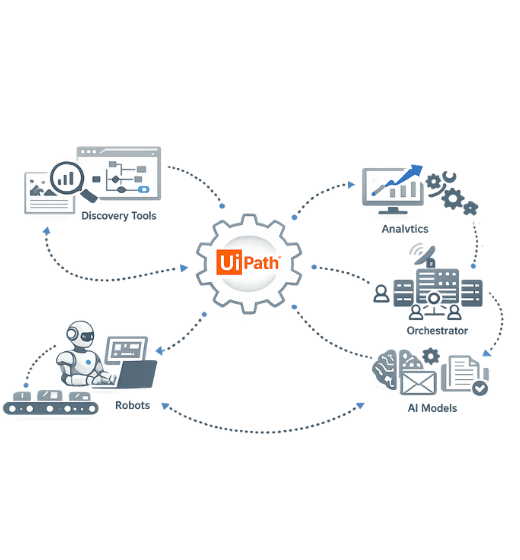
- A process begins with discovery through mining tools. Automation workflows are designed and deployed via UiPath Studio. Robots execute tasks while AI models handle decision-making and unstructured inputs. Orchestrator manages execution, while analytics continuously refine performance.
- UiPath Orchestrator centrally manages execution, scheduling, and governance, ensuring control and visibility across all automation activities. Monitoring and analytics track performance, detect issues, and provide actionable insights. These insights are used to continuously refine workflows, improve accuracy, and optimize outcomes. This creates a closed-loop automation system where processes are not only executed efficiently but also evolve over time, becoming more intelligent, scalable, and aligned with business goals.
Human + Machine Collaboration at Scale
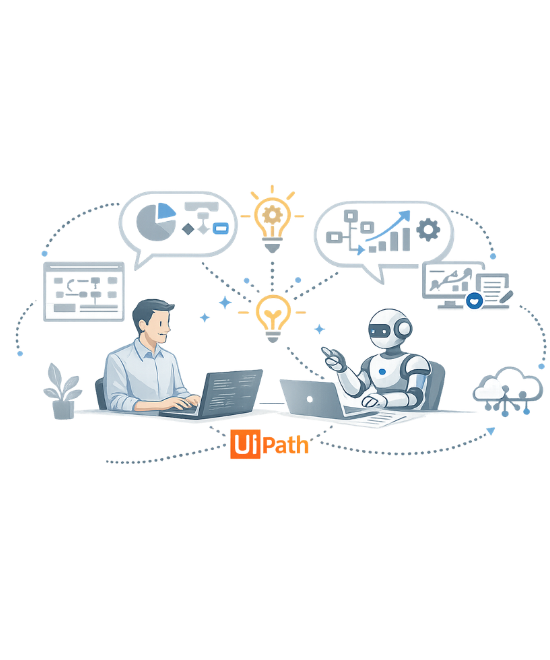
UiPath integrates AI copilots and automation assistants to enhance both human productivity and system efficiency. These copilots act as intelligent interfaces that assist users in executing tasks, generating workflows, and making informed decisions in real time.
Automation Across Your Enterprise Stack
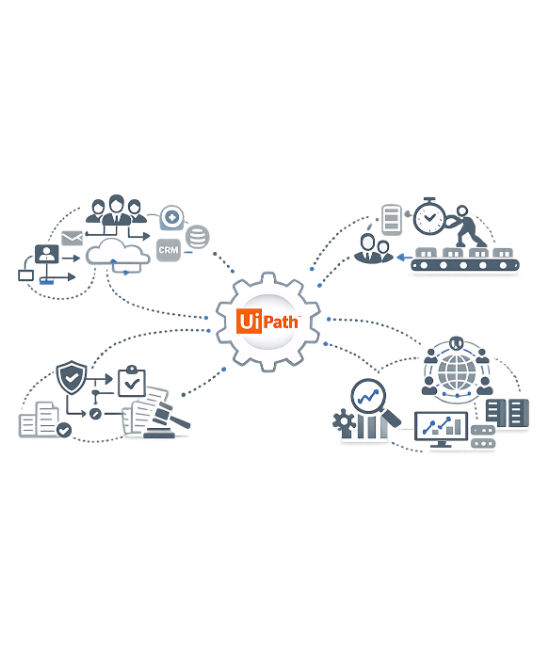
UiPath integrates seamlessly with enterprise systems such as SAP, Oracle, Salesforce, and legacy applications, enabling unified automation across diverse environments. Through APIs, pre-built connectors, and UI automation, it can interact with both modern and legacy systems without requiring major infrastructure changes. This flexibility allows organizations to automate processes across disconnected systems, bridging gaps between applications that were not originally designed to work together. Bots can extract, transfer, and update data across platforms in real time, ensuring consistency and eliminating manual intervention.
It also supports hybrid environments, where cloud and on-premise systems operate together, enabling smooth integration without disrupting existing operations. This reduces the need for costly system replacements while extending the value of current infrastructure. By creating a connected automation layer across the enterprise, UiPath ensures seamless data flow, improved operational efficiency, and the ability to scale automation across complex system landscapes.
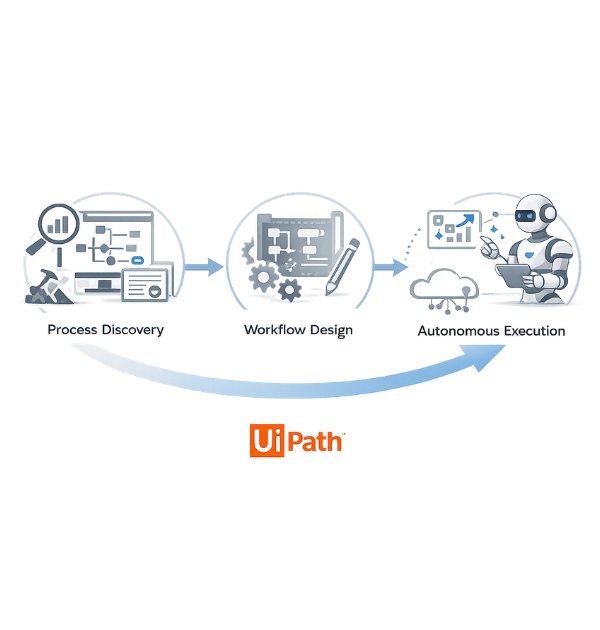
From Process Discovery to Autonomous Execution
We begin by identifying automation opportunities using process intelligence tools, followed by designing scalable workflows aligned with business logic. Our focus is on building automation systems that are resilient, governed, and continuously optimized.
Frequently Asked Questions
What makes UiPath different from other RPA platforms?
This allows organizations to automate entire workflows rather than isolated tasks. With tools for discovery, development, execution, and monitoring, UiPath enables end-to-end automation at scale. Its strong developer ecosystem and low-code capabilities also make it accessible across teams.
What is agentic automation in UiPath?
Unlike rule-based automation, these agents can handle variability and complex scenarios with minimal human intervention. This enables more dynamic and autonomous workflows, especially in environments with unpredictable inputs. It represents the next evolution of automation beyond static scripts.
Can UiPath handle complex, multi-step processes?
It supports both attended and unattended automation, allowing seamless execution across different environments. With orchestration and workflow management capabilities, UiPath ensures that processes are executed in the correct sequence with proper error handling. This makes it suitable for enterprise-grade operations.
How does UiPath use AI in automation?
These capabilities enable the platform to process unstructured data, make decisions, and improve over time. AI enhances automation by handling tasks that require interpretation, such as reading documents or understanding text. This allows organizations to automate more complex and real-world processes.
Is UiPath suitable for enterprise-scale deployment?
It supports thousands of bots across multiple departments and geographies while maintaining control and visibility. Its cloud and on-premise options provide flexibility based on organizational needs. This makes it ideal for enterprises looking to scale automation initiatives effectively.
Can UiPath integrate with legacy systems?
It allows bots to mimic human interactions with applications, enabling automation without requiring system changes. This is particularly useful for organizations with older infrastructure that cannot be easily replaced. It ensures smooth automation across both modern and legacy environments.
How do you measure automation success?
It also includes improvements in scalability and the ability to handle higher workloads without additional resources. Beyond operational metrics, success is evaluated based on overall business impact and ROI. This ensures automation delivers tangible value rather than just activity.
What is the biggest advantage of UiPath?
This enables organizations to build scalable, intelligent automation systems that continuously improve over time. By integrating discovery, execution, and optimization, UiPath transforms automation into a strategic capability rather than a tactical tool.
Let’s Collaborate with Us!
From an early stage start-up’s growth strategies to helping existing businesses, we have done it all! The results speak for themselves. Our services work.